

Yes, the AP Poll matters
And it should give you pause that people want you to think it doesn't.

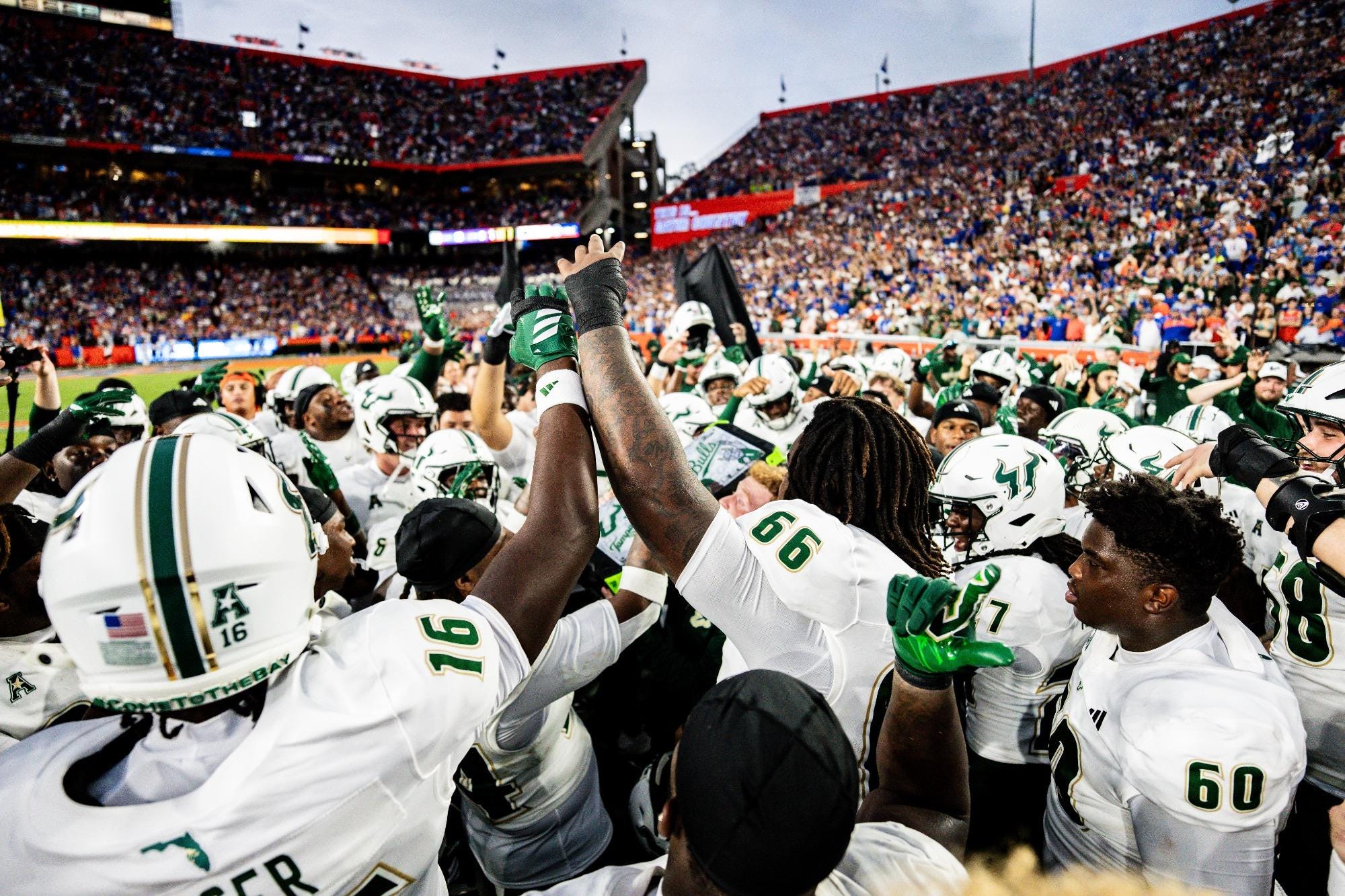
On Saturday, the up-and-coming South Florida Bulls pulled off one of the biggest upsets of the college football season so far. Under the oppressive roar of nearly 90,000 fans in one of the sport’s most intimidating road environments, they overcame an 18.5-point spread in favor of 13th-ranked Florida and pulled off a stunning 18-16 victory—their first ever against the Gators. That remarkable accomplishment lifted USF to 18th in the AP Poll, snapping a seven-year drought since their last top-25 appearance. At the same time, it dropped Florida out of the rankings completely, an unsurprising and well-deserved punishment for a program that hasn’t made it past September with a number by its name since 2021.
Not everybody, however, was so convinced.
If you’ve been in social media in the past couple days, there’s a good chance you’ve heard some discussion about AP voter Haley Sawyer. Her rankings didn’t feature preseason #15 Florida at all—an unusual choice, though given recent results a very understandable one—but she quickly adjusted and jumped the Gators up to #16 in Week 2 after a dominant victory1. Then Florida lost to USF (who she didn’t have ranked) at home, and in Week 3 she…moved UF up to #14? What?
Sawyer’s response to widespread criticism of her ballot was as follows:
…as far as what my votes are and what my process is…you know, I wake up early in the morning after covering a game late the night before. Don’t want to go too much into my process or logic, but I will say, I appreciate everybody’s interaction on social media and all of your feedback. You know, there’s tons of people that vote on the AP poll, and it’s not a perfect system, but at the end of the day, no matter who you pick it does even out, because there’s so many people who vote. And like I said, it’s really fun for discussion…it doesn’t, you know, probably matter in the end, but I’m glad that people are having a really good time with it.
So, in short: the AP Poll doesn’t matter, so why get worked up about it? That’s a good question—or, at least, it seems like a good question. After all, this poll doesn’t really decide…well, anything! For all intents and purposes, it’s a purely cosmetic ranking, one which sets the numbers that appear on sports sites and broadcasts and does little else. That wasn’t always the case, but it is now.
This is the argument plenty of people have turned to in defense of Sawyer, as well as the numerous other questionable ballots submitted to the AP Poll on a regular basis2. It’s really not that big of a deal! There’s an established culture around picking apart this ranking because it used to matter so much—back when it was a factor in the BCS rankings and before that, the be-all and end-all of deciding who was #1 at the end of the season—but nowadays, the task of ranking teams for the actual playoff selection falls to the CFP committee instead. So who really cares what the old, outdated poll has to say?
…well. The SEC certainly does.
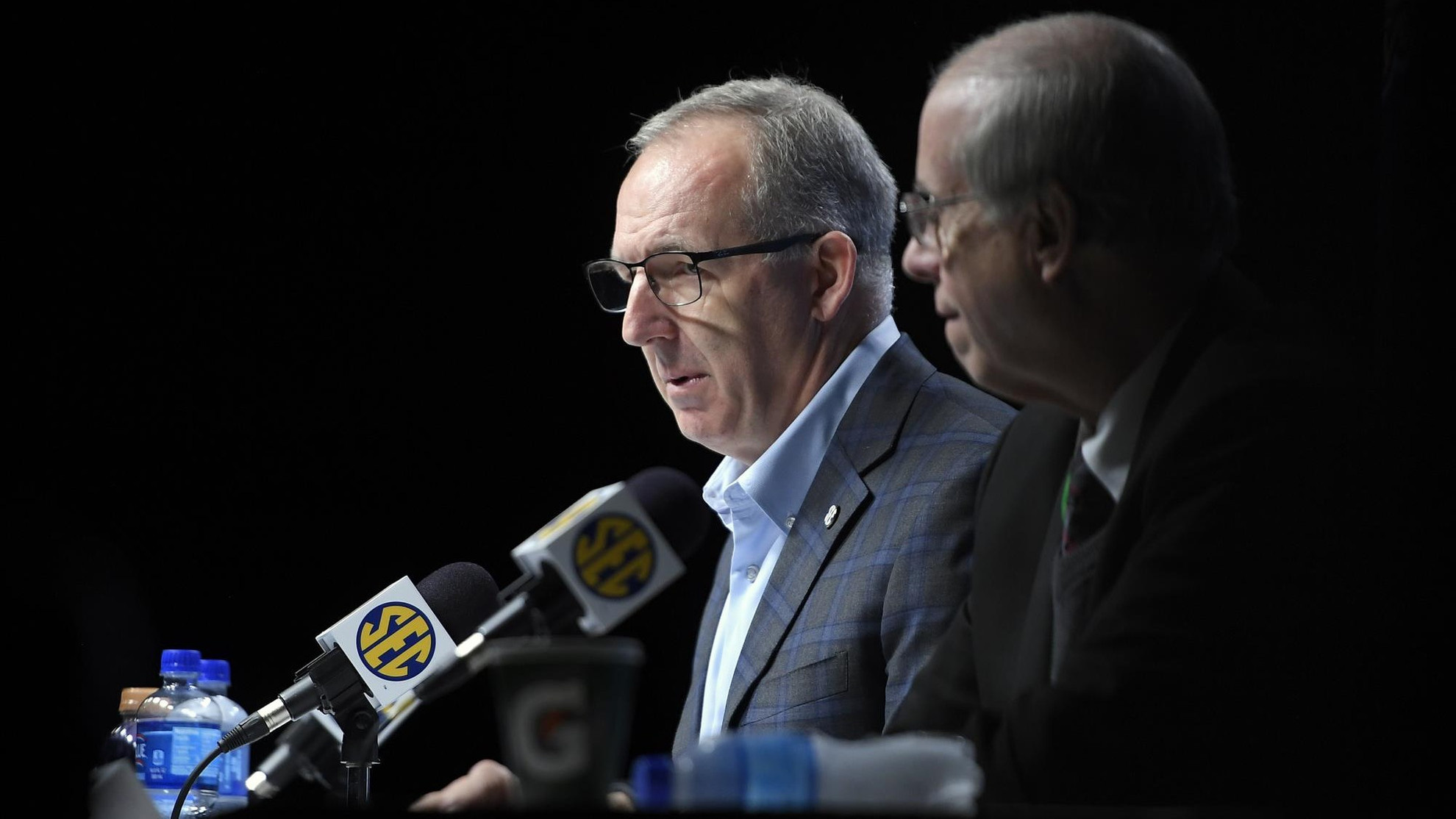
Despite Florida’s fall from the rankings, the Southeastern Conference placed a record eleven teams in the AP top 25 this week, thanks to both Auburn and Missouri climbing in at #24 and #25. And the league certainly considers that achievement worth celebrating; the SEC’s official site has an article for it, the Twitter account has two tweets bragging about it, the separate SEC Network Twitter account posted about it, and so on and so forth.
The conference and its bedfellows—chiefly ESPN, which has been deeply entangled with SEC football for years and also holds the exclusive media rights of the College Football Playoff3—frequently brandish the AP rankings as a talking point to prove their superiority. In recent years, they’ve shown a particular affinity for doing so early in the season, when league comparisons are in flux thanks to the heavy slate of out-of-conference games. Around this time last year, for instance, the topic of discussion was about the SEC’s record six out of the top seven teams.
(No mention then, of course, of the fact that the conference only had two other teams in the top 25. No mention of the fact that “number of teams in the top seven” isn’t a record anybody had ever cared about until the SEC noticed they had it. And no mention now of the fact that the Big Ten has three of the top four teams, the first time any league has done that since they themselves had four of the top five last November, again to little fanfare. Curious.)
The SEC cares a lot about these rankings, especially this time of year, because they set the tone for the season. If it’s seen as the top conference when OOC games peter out and most SEC teams are playing almost exclusively other SEC teams, it’s basically guaranteed to hold that status right through to the playoff selection show. And if the CFP results damage that reputation a little—such as last year, when the conference got only one team to the semifinals and none to the championship? Well, it’s easy to recoup those losses by playing their cards right next September, when any complaints can be swept aside by pointing out that the AP Poll doesn’t really matter.
The CFP committee makes a big song and dance out of the fact that their ranking is completely independent, unswayed by any preseason rankings or emotional biases. But it doesn’t take much thought to see that this simply isn’t true. To take a recent example: in 2024, Penn State opened the season 7-1 with a close loss to #2 Ohio State and, at least at the time, no meaningful wins; their best was a victory over unranked Illinois, which limped out of Week 9 with back-to-back losses and a 6-3 record. Meanwhile, SMU was 8-1 with a close loss to #9 BYU and ranked wins over #22 Louisville and, that very week, over #18 Pitt in dominant fashion. All of the ranks listed above are from the CFP’s top 25 following those results, their first ranking of the season, which also included the following: #6 Penn State, comfortably in line for a home playoff game, and #13 SMU, outside the projected CFP bracket entirely. You wanna guess which team started top-ten in the AP Poll and which didn’t get a spot until October?
Preseason and early-season expectations clearly matter to the committee. You can give them the benefit of the doubt that they try to avoid bias, but most of them are current or former D1 athletic directors and coaches. Some of them can’t ignore what’s going on in college football until it’s time for them to evaluate the season as a whole…and realistically, we all know that none of them do. The jockeying for position that power conferences do every September makes a difference when the committee gets together in November, and it doesn’t have much to do with the actual results.
There’s a fine line between incompetence and malice. Nowhere is that more true than in college athletics; this whole sport is such a mess, with so many teams and games and regulations and potential biases, that if you cover it long enough, you will screw something up. Haley Sawyer is anything but a unique case, and I’m inclined to believe that her bizarre ranking decisions this week were more of a mistake than an active attempt to bolster the SEC’s questionable conference credit.
Much more concerning, at least to me, is the counterattack leveled against those who take issue with a ballot like this. The AP Poll doesn’t matter? Buddy, this is college football. Nothing could possibly matter more in this confusing, overcomplicated monolith of a sport than a ranking with the dubiously-accurate appearance of credibility. Playoff spots, and ultimately championships, are won on this battlefield, just as much as on the actual field.
In a perfect world, sure, we wouldn’t have to worry about what this ranking claims to be the truth. It’s flawed for so, so many reasons—its reporters are obviously biased for the teams they cover, its tight turnaround time encourages slapdash ballots that miss key results, and its national coverage is guided by a network with obvious conflicts of interest—and frankly, if we could all discard the rankings until November like the committee purports to do, we’d be better off for it.
But this world is the one we’ve got, and as far as I’m aware, the AP Poll has no plans to cease its stubborn march forward into year after year of uninformed early-season takes (that inevitably inform late-season dogma). As long as we’re stuck with this ranking, it’s bound to affect how people view the championship chase—including the people who decide who gets a chance to win it.
Of course the AP Poll matters.
As much as we might wish it didn’t.
Against LIU, an FCS team which hasn’t had a winning season since moving to Division I in 2019, but that’s neither here nor there.
A few highlights from elsewhere in this week’s poll, for example: Koki Riley had Florida #5 last week, then dropped them to #15 while ranking USF only #20 for beating a team he had in the top five on the road. Aaron McMann has Florida #16 this week and Tennessee, which has finished in front of Florida in the SEC for four straight years and also hasn’t lost this season, entirely unranked. Keith Farmer has Arizona State #16 this week and Mississippi State, who beat them 24-20 on Saturday, unranked. Henry Greenstein has SMU #18 this week and both Baylor (which beat SMU this week) and Auburn (which beat Baylor the week before) unranked.
Don’t worry, though! There’s no way this close connection to the SEC has had an effect on any of the CFP committee’s selections. Probably. Don’t fact-check that, by the way.